“I’m mad as hell, and I’m not gonna cum anymore!”
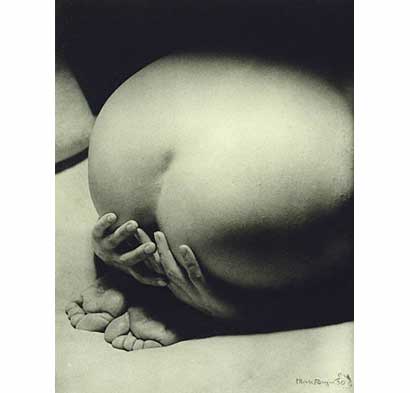
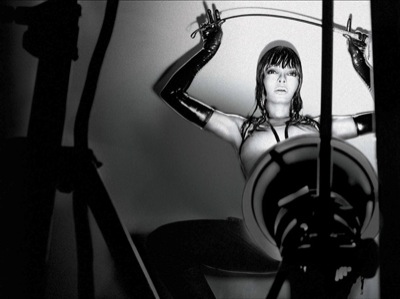
What creates a masochist? It’s not a question that most people know how to answer, mostly because it forces them to define masochism and determine their standing in relation to it (one of my favorite reviews of this film, from a woman on Netflix, opens with the insistent disclaimer that she has no connection to the world of S and M). Most have opinions of sadomasochism that come from any number of cultural sources – be they as high art as Man Ray’s nudes or as bottom of the barrel as Janet Jackson’s new album art. Sexual domination even has a strange place in American comedy: remember Lucy Liu’s gestalt therapist in Charlie’s Angels or the Gimp in Pulp Fiction. Indeed, humor may be an essential comfort to those curious about sadomasochism but afraid of it. Whether that distance is necessary or healthy is not the question that Kirby Dick’s Sick: the Life and Death of Bob Flanagan, Supermasochist is out to answer. One could even say that Sick is not about answering any questions, or even about provoking discussion – it’s about immersing people in one specific individual’s life while constantly reiterating the limits to understanding him. Since we’re not sick, and the film presumes that we don’t want to be, it takes us as close as it can, while making sure we know that gesture is ultimately meaningless. A movie is not a person and seeing is not experiencing.
Bob Flanagan suffered from Cystic Fibrosis, a hereditary lung disease that makes most body functions, but especially breathing, difficult. For decades, life expectancies for those with the disease didn’t give them much hope past childhood – however, for a time, Flanagan held the world record for living CF (he died at 43). Early in the film, we are told that two of his five siblings (both sisters) died from it. A TV interview with Steve Allen in 1962 shows a young Flanagan dismissing Allen’s hope that he grow up to be an artist by explaining he wants to be a doctor. He ends up synthesizing the two in a unique and terrifying way, by becoming a self-proclaimed “supermasochist” and blazing frontiers in the limits of punishing his body and documenting that punishment. For a time, he is alive (never healthy) and celebrated in infamy (he collaborates with a handful of musicians and has his work displayed in galleries). Sadly, he succumbs to the disease and dies in early 1995.
The first shots of the movie show confusing (and confused) hints of the pain he endures, with Flanagan screaming (or laughing, or even in the throes of bliss – it’s difficult to tell). The close-ups are immediately unsettling, with Flanagan’s sweaty face appearing closer than we want. What we don’t see is worse than we what do – Flanagan in zombie make-up, Flanagan getting a pie in the face, Flanagan drinking something out of a baby bottle. Then, the close-ups stop and Flanagan introduces himself by reading his obituary. From the beginning, we understand the risk of caring too much about this person by having the limited information we are told about state and restate that he is dying. All his life he was told to expect to die, so the movie has to introduce and reiterate that fear constantly.
The film is less documentary and more artistic statement, but even that is obscured by the difficulty of empathizing with a man who is in more pain than most of us can or want to understand (especially when most of that pain is self-inflicted). Those jaded by the filmic violence of Takashi Miike or Chan-Wook Park may well not know how to react to quick shots of Flanagan’s lips sewn shut or genitalia piercings, never mind his need to be “slapped . . . screwed . . . sodomized . . . sutured . . . and spent.” Not only is the violence real, but it’s presented in a unique curative way. Never mind Hollywood’s idea of “violence as catharsis;” this is violence as internal conflict, with little effect beyond delaying the inevitable. Viewers find themselves surprised by how much they care about Bob and how mad they get at him for the awful things he does to himself.
This leads to a somewhat disappointing gambit in the final third, in which, after seeing Flanagan’s performance art peak (in a gruesome scene known by most as the “Hammer of Love”), he drives himself to a hospital and, after an undisclosed time in ER, dies. Quick, mortifying shots of the man’s face with his eyes bulging out of his skull as he struggles to understand what’s happening to his body are cut with a nurse confiding to him, “It’s okay.” Interviews in the hospital waiting room with his wife/artistic partner Sheree Rose (more on her later) show the intelligent and outspoken woman stammering to find a cohesive point to say about losing her lover and partner. The emotional pitch here is overwhelming, as we see someone we’ve spent 70 minutes recognizing as a unique, funny and loving person die. I understand Dick and Rose’s desire to immerse us in their friend’s life, but the recordings of his death itself (and posthumous photos shown after) emphasize only that the man who was the movie’s ghoulish heart is gone. Even if that was the director’s point, it doesn’t seem so much in keeping with Flanagan’s masochism as it does unnecessarily mean.
Much of the narrative of the film is based on Flanagan’s performance art pieces, covering about twenty years of his life. Beyond his recorded statements, in videos and art installations, we see his wife, Sheree Rose, and come to understand the degree to which the duo defined their careers through each other. Rose was not so much the Frankenstein to Flanagan’s Monster as she was his unlikely nurse and protector – one gets the feeling that she was unprepared for the emotional responsibilities that he drew from her, even in giving her total control over his mind and body. One of the duo’s funniest and most unnerving films, a short called “Leather from Home,” is used to introduce Rose to viewers. It’s a parody of idealized 1950s views of love, as we see Flanagan writing his parents a letter describing Rose and how she has changed him. The piece is underscored with dark irony, as Bob promises his parents that they won’t believe what his partner can do with a piece of meat and we see her pounding a steak with a hammer. He promises he’ll be “hanging around” with Rose for a while, and, of course, we see him gagged and bound from her ceiling in the dark. “Leather from Home” is important because it shows us a vital part of the humor, not just the sex and violence that united these two people, and because it deliberately re-frames their creative collaborations to serve a narrative purpose. While Flanagan and Rose used the short film to satirize telling mom about “the one,” director Kirby Dick uses the film as an actual introduction to Rose and the more intense components of Flanagan’s life. It’s as much of an orientation as we are allowed, and it comes from the artists themselves, as though to say “You can appreciate this stuff for what it is, but you don’t dare make any judgments of it."
Sick is an excellent, powerful and in-depth film, but not a perfect one. It raises some questions that assume either a familiarity with the subject (his controversial video collaboration with Nine Inch Nails is shown without any context or explanation), or a lack of interest in the peripheral details of his life (what was his family’s relationship with Rose, a woman who spent hours of videotape humiliating and hurting their sick son, even if she was keeping him alive? What happens to her without Bob?). Bob's religious faith (he was Catholic) and its impact on his art, is limited to one soundbite. A lot of what a person takes out of any film is what they’re willing to put it into it, but that might be especially true of this moving and intense documentary. It takes a discerning viewer to weigh the horrific things Bob did to himself with the candor he used to speak about his life and a brave one to tolerate both together.
The film’s most emotional and interesting moment is a short segment showing Flanagan as a CF summer camp counselor. Text crawl explains he worked there for decades, almost as long as he was into S and M, and shows him at ease with the campers as he serenades them with a Bob Dylan parody entitled “Forever Lung.” This is the man at his most personal and powerful, adapting pop culture to inspire others and serving as artist and doctor.
NOTES:
1. Bob Flanagan has one other credit to his name on the IMDB: The New Age, a satire of Hollywood excess from 1994 (from the director of The Rapture, no less!). He appears as himself for a little less than a minute. How do you know it’s him? He’s leading a discussion at an S and M party (funnily enough, wearing the most conservative outfit there) and someone else there calls him “Bob.” His two lines of dialogue refer to the importance of the body in dictating one’s needs. It’s a neat little factoid that no one else seems to have mentioned. Can you connect Bob to Kevin Bacon in less than four steps? (HINT: Samuel L. Jackson and Adam West are also in The New Age).
2. Bob is seen reading from RE:Search – Bob Flanagan, a book published by the infamous punk literature label based in California. All of Flanagan’s books are out-of-print (and go for hundreds of dollars on eBay), but this one goes for less than its cover price, if you keep up on Amazon.com.
3. I’d like to hope that, sometime in the next decade, Bob will get the bio-pic treatment. Toby Maguire with a crew-cut and Sigourney Weaver would do excellent work as the couple.
4. If you see this on DVD, it’s essential that you check out Sarah’s Sick Too, a sequel of sorts following up on Bob’s interactions with a young woman with CF who met him through the Make-a-Wish foundation. As of the DVD’s release, she’s still alive and aims to beat the record for living with the disease. Get well soon, but stay sick forever, indeed.
 Please don't sue me, Chris Onstad.